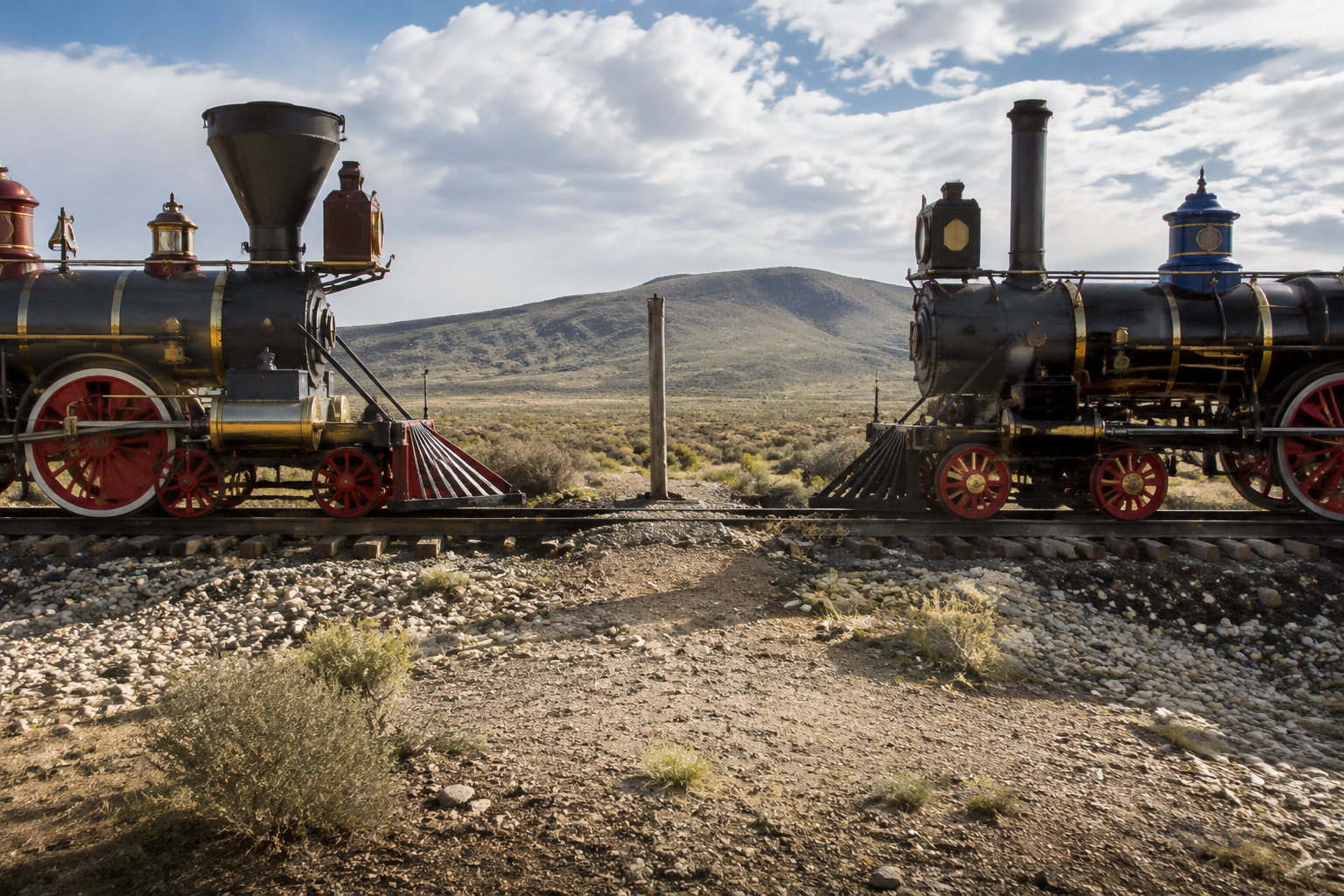
On May 10, 1869, at Promontory Summit in Utah, a ceremonial golden spike joined two railroads and, with them, a continent. The completion of the first transcontinental railroad was one of the most transformative events in American history.
An Enormous Undertaking
Two companies built toward each other: the Central Pacific, working eastward from Sacramento, California, through the formidable Sierra Nevada, and the Union Pacific, building westward across the Great Plains from the Missouri River. The project required blasting tunnels through granite, bridging rivers and laying track across deserts and mountains.
The Workers
The labor was brutal and the workforce remarkable. The Central Pacific relied heavily on thousands of Chinese immigrant workers, who performed some of the most dangerous tasks, including tunneling through the Sierra in deep snow. The Union Pacific employed many Irish immigrants and Civil War veterans. Their labor — often underpaid and underrecognized for generations — made the railroad possible.
The Golden Spike
When the two lines met at Promontory Summit, a ceremonial final spike of gold was tapped into place, and the news was telegraphed across the country, sparking celebrations. The event is often called the moment the nation was “joined.”
How It Changed America
The railroad shrank a journey that once took months into a matter of days. It accelerated settlement of the West, knit together a national economy, and standardized time zones to keep schedules. Goods, people and ideas moved as never before.
A Complicated Legacy
The railroad’s benefits came at a cost. Its construction accelerated the displacement of Native American nations and the decline of the bison herds central to their way of life. As with much of westward expansion, progress for some meant profound loss for others.
Visiting Today
Golden Spike National Historical Park in Utah preserves the site, with replica locomotives and reenactments of the 1869 ceremony. Standing on the spot, it is easy to grasp how a single line of track reshaped a nation.