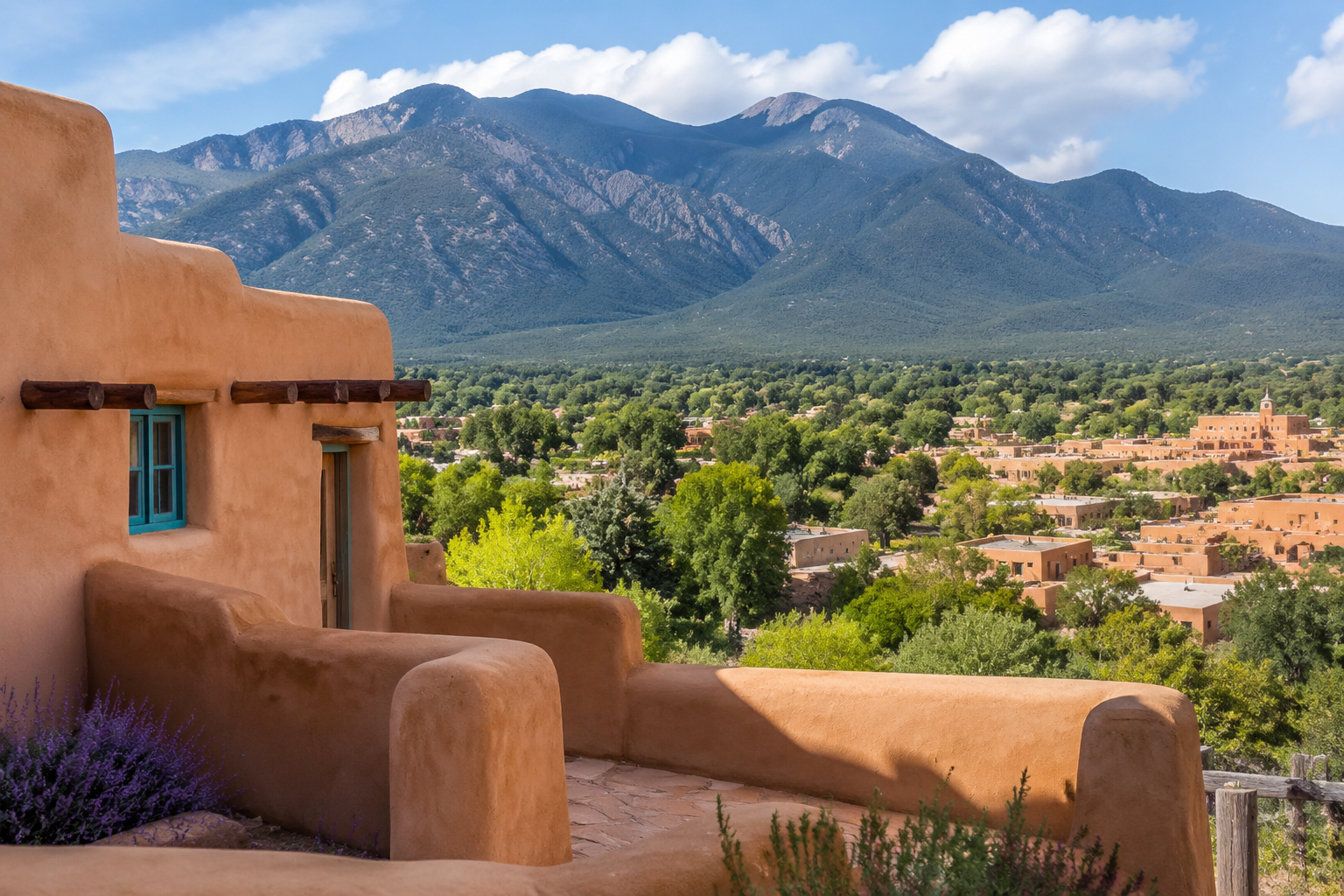
Northern New Mexico feels unlike anywhere else in the United States — a high-desert landscape where Native American, Hispanic and Anglo cultures have layered over centuries, all under a famously luminous sky.
Santa Fe
Founded over 400 years ago, Santa Fe is one of the oldest cities in the country and the highest state capital, at about 7,000 feet. Its adobe architecture and walkable historic center make it a joy to explore on foot. Visit the central Plaza, the Palace of the Governors, and the remarkable Loretto Chapel with its mysterious spiral staircase. The city has one of the largest art markets in the country, anchored by the galleries of Canyon Road and the Georgia O’Keeffe Museum.
The High Road to Taos
Rather than the direct highway, take the High Road to Taos, a scenic byway winding through mountain villages, old churches and artisan studios. Stop at the adobe church of San José de Gracia and the weaving village of Chimayó, home to a historic shrine.
Taos
Taos is smaller and more bohemian, long a magnet for artists drawn by the light and landscape. The crown jewel is Taos Pueblo, a multi-story adobe complex continuously inhabited for roughly a thousand years and recognized as a World Heritage Site. Visit respectfully — it is a living community. Nearby, the Rio Grande Gorge Bridge spans a dramatic chasm hundreds of feet deep.
Food and Culture
New Mexican cuisine is its own tradition, built on red and green chile. When a server asks “red or green?” — the official state question — you can answer “Christmas” to get both. Try enchiladas, posole and sopaipillas drizzled with honey.
When to Go
- Fall brings golden aspens and pleasant temperatures.
- Winter offers skiing at Taos and a magical holiday season of farolito lights.
- Summer is warm but tempered by the elevation.
Santa Fe and Taos reward slow travel and curiosity. Linger over the art, the food and the history, and the high desert works its quiet magic.