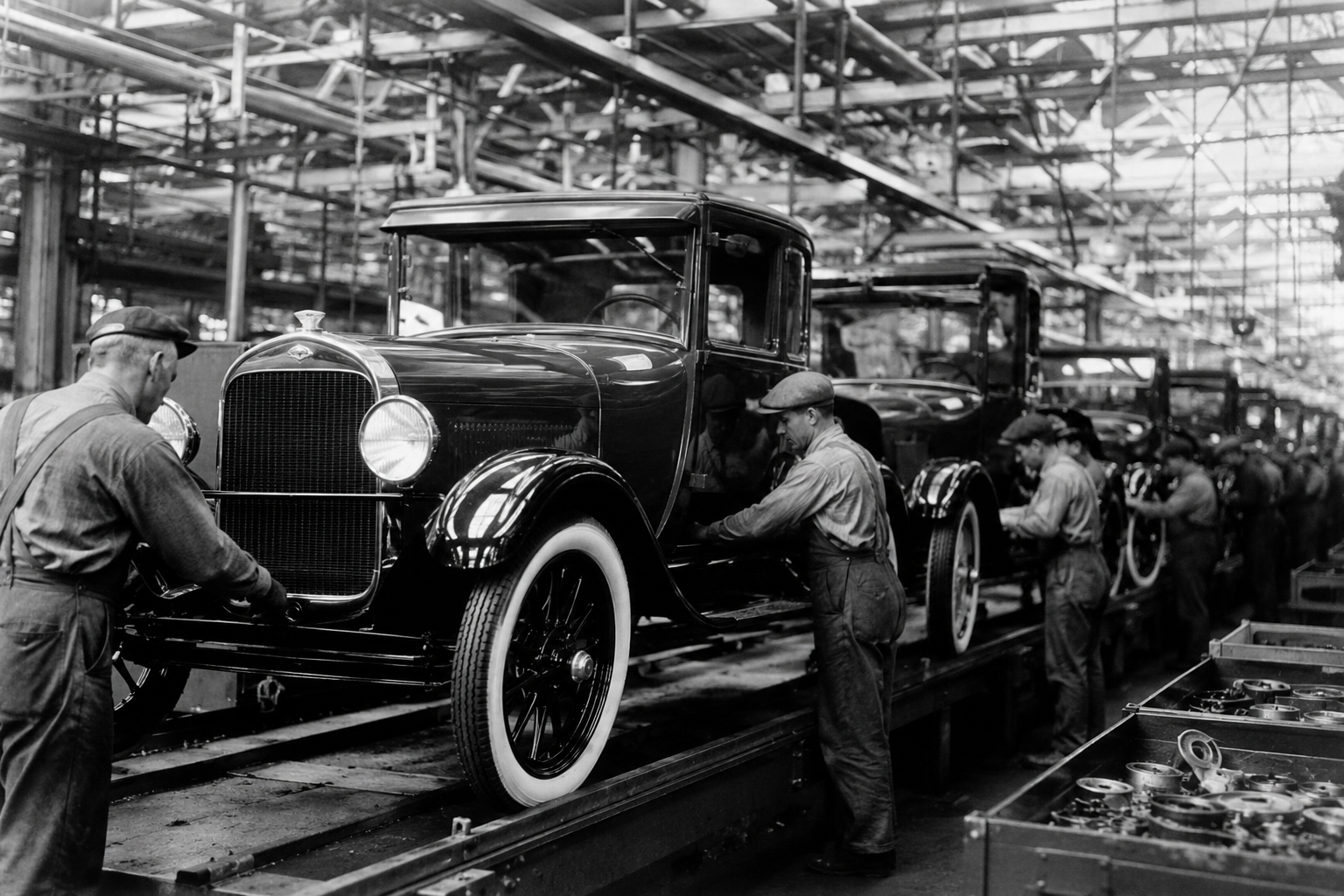
In the early 20th century, the city of Detroit, Michigan, became the center of a revolution that would reshape the world: the mass production of the automobile. The story of “the Motor City” is the story of how America learned to build, and to move.
Why Detroit
Detroit had advantages: access to Great Lakes shipping, nearby raw materials, a skilled workforce from earlier industries, and a cluster of inventive entrepreneurs. By the early 1900s, several automakers had set up shop there.
Henry Ford and the Assembly Line
The pivotal innovation came from Henry Ford. In 1913, Ford introduced the moving assembly line at his factory, drastically cutting the time needed to build a car. The Model T, already simple and durable, became affordable for ordinary families. Ford also stunned the industry by offering a $5 workday, attracting workers from across the country and the world.
The Great Migration
The promise of factory jobs drew hundreds of thousands of people to Detroit, including many African Americans leaving the rural South in the Great Migration. The city’s population boomed, and Detroit became one of the largest and most prosperous industrial cities in the nation.
Labor and the Middle Class
Auto work was hard and dangerous, and the 1930s saw fierce struggles to organize labor unions. The eventual rise of the United Auto Workers helped secure wages and benefits that lifted many factory workers into the middle class, a model that influenced American industry broadly.
Boom, Decline and Reinvention
The industry powered Detroit through mid-century, but later decades brought automation, foreign competition and the movement of jobs away from the city. Detroit faced serious economic decline. In recent years, the city has worked to reinvent itself, blending its industrial heritage with new investment and culture.
Detroit’s rise shows how a single industry can transform a city — and how the assembly line that started there changed not just transportation, but the rhythm of modern work itself.