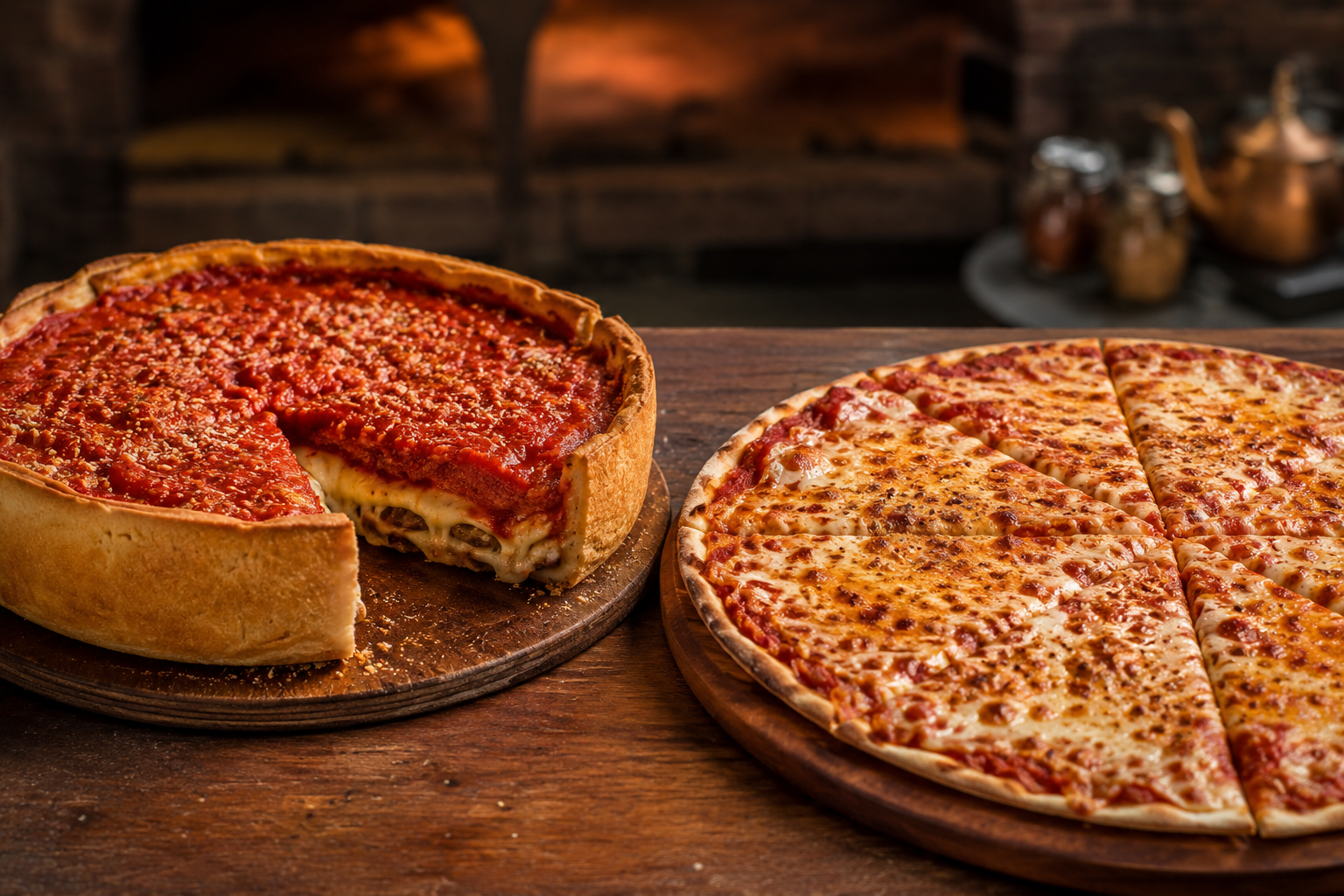
Few food debates are as heated as the one between Chicago and New York over pizza. Both cities are passionate, both are convinced they are right, and the two styles could hardly be more different.
The New York Slice
New York-style pizza is defined by its large, thin, foldable slices. The crust is thin but sturdy, with a crisp bottom and a chewy edge, traditionally baked in a hot deck oven. The classic is simple: tomato sauce and mozzarella, sold by the slice from countless corner pizzerias. Locals fold the slice lengthwise to eat it on the go. Many credit the city’s water for the distinctive dough.
The Chicago Deep-Dish
Chicago deep-dish flips the concept. Baked in a high-sided pan, it is built almost like a pie: a thick, buttery crust lines the pan, followed by a layer of cheese, then fillings, and finally a chunky tomato sauce on top. It is hearty, requires a knife and fork, and takes much longer to bake. Chicago also claims tavern-style thin pizza, cut into squares — a local favorite that outsiders often overlook.
Which Came First
New York’s pizzerias date to the early 1900s, brought by Italian immigrants and inspired by Neapolitan pizza. Chicago’s deep-dish emerged later, in the 1940s, as a distinct American invention. Purists in each city tend to regard the other’s version as something else entirely.
Beyond the Big Two
America’s pizza map is bigger than this rivalry. Detroit-style pizza, baked in a rectangular pan with a crispy, cheesy edge, has surged in popularity. New Haven, Connecticut, is famous for its coal-fired “apizza,” including a white clam pie. St. Louis has its cracker-thin crust and Provel cheese.
So Who Wins?
The honest answer is that they are different foods that happen to share a name. A New York slice is a quick, foldable street food; a Chicago deep-dish is a sit-down meal. The best approach is to skip the argument and enjoy both on their own terms — ideally in the cities that perfected them.