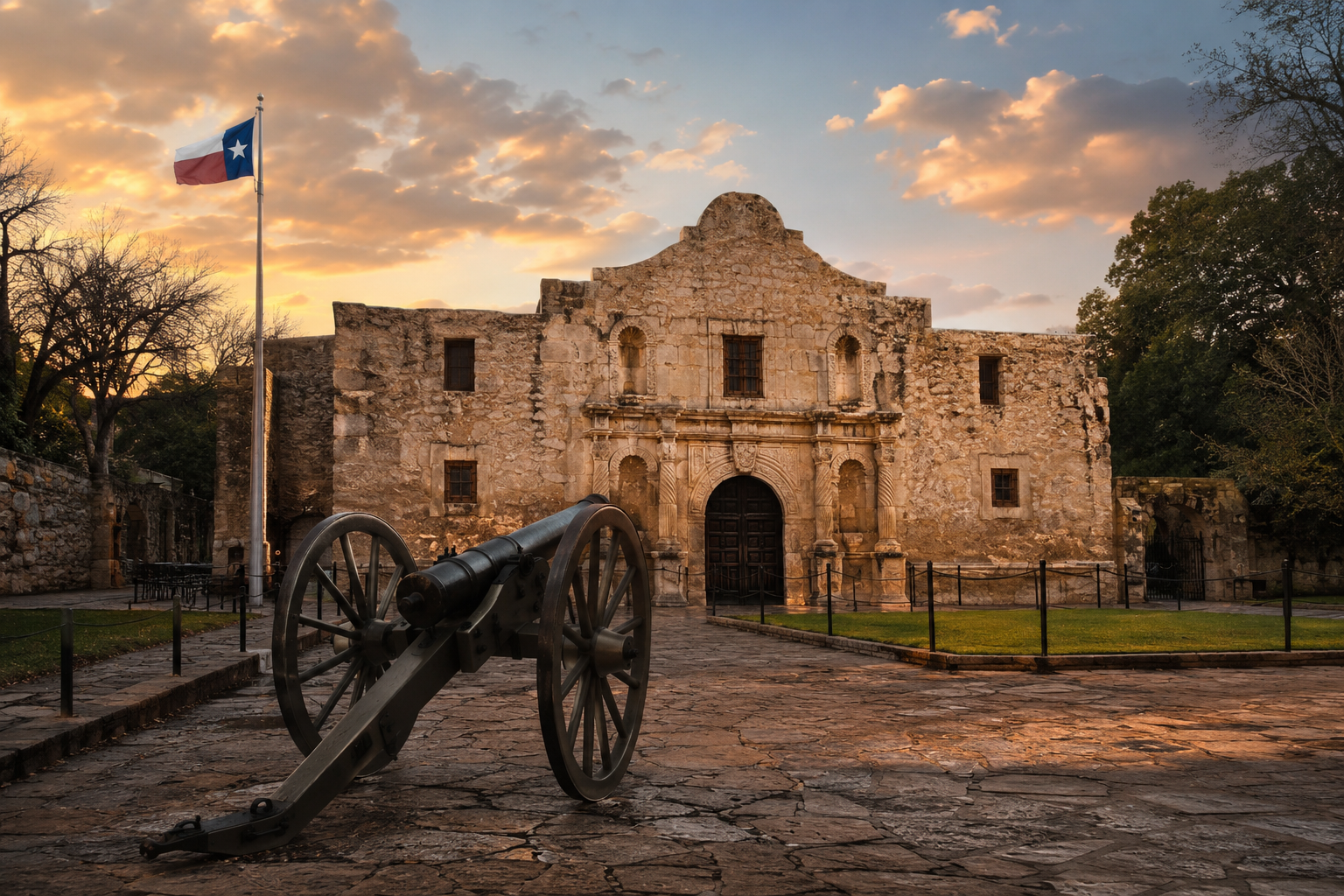
“Remember the Alamo” is one of the most famous rallying cries in American history. The story behind it unfolded over thirteen days in 1836 at a former Spanish mission in San Antonio, Texas, during the Texas Revolution.
Background
In the 1830s, Texas was part of Mexico, but a growing population of American settlers and Tejanos (Texans of Mexican descent) had come into conflict with the centralizing government of Mexican President Antonio López de Santa Anna. The tensions erupted into revolution.
The Siege
A small force of Texan defenders — fewer than 200, including famous frontiersmen Davy Crockett and Jim Bowie, under the command of William Travis — occupied the Alamo, a fortified former mission. Santa Anna arrived with a much larger army and laid siege. According to legend, Travis drew a line in the sand, inviting those willing to stay and fight to step across.
The Final Assault
On the thirteenth day, Mexican forces stormed the walls before dawn. The defenders were overwhelmed, and nearly all were killed. Santa Anna’s costly victory, however, became a strategic disaster.
The Aftermath
News of the Alamo’s fall enraged and galvanized Texans. Weeks later, at the Battle of San Jacinto, General Sam Houston’s army shouted “Remember the Alamo!” as they routed Santa Anna’s forces in a battle lasting only about 18 minutes. Santa Anna was captured, and Texas won its independence, becoming the Republic of Texas.
The Alamo Today
The Alamo still stands in the heart of downtown San Antonio, preserved as a historic site and museum visited by millions each year. Its iconic facade is one of the most recognized images in Texas. Modern interpretation increasingly explores the site’s full history, including its origins as a mission and the diverse people involved in the events of 1836.
More than a battle site, the Alamo became a symbol of sacrifice and determination that remains central to Texas identity.