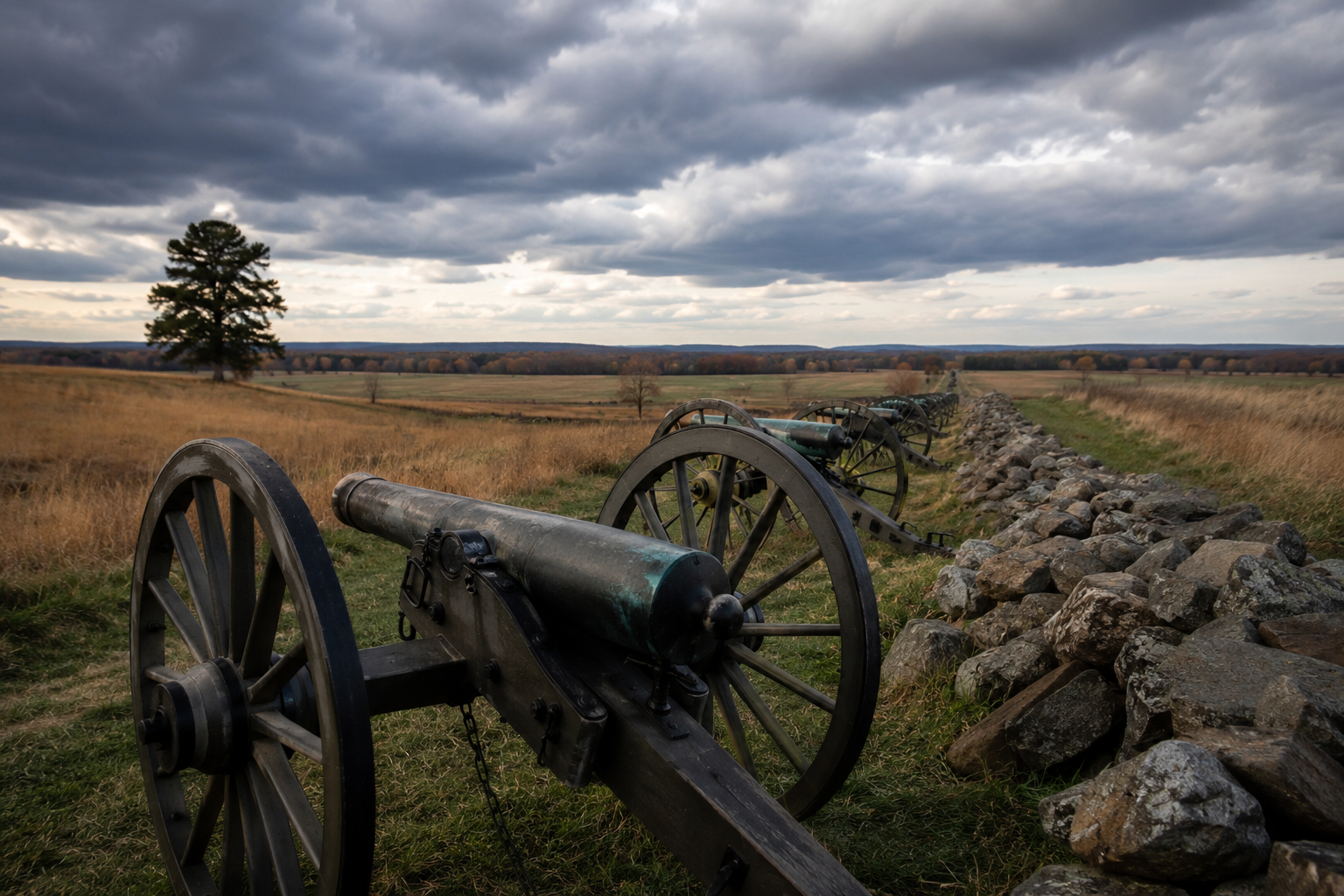
In the first three days of July 1863, the small town of Gettysburg, Pennsylvania, became the site of the largest and bloodiest battle ever fought in North America. Its outcome marked a turning point in the American Civil War.
How the Armies Met
Confederate General Robert E. Lee had pushed his army north into Pennsylvania, hoping a victory on Union soil might break Northern resolve. Union forces under General George Meade moved to intercept. The two armies collided almost by chance at Gettysburg, a town where several roads converged.
Three Days of Fighting
On the first day, Confederate forces drove Union troops back through the town to defensive heights to the south. On the second day, fierce fighting raged at places whose names became legendary: Little Round Top, the Wheatfield, the Peach Orchard. On the third day, Lee ordered a massive frontal assault on the Union center — known as Pickett’s Charge — across nearly a mile of open field. It was repulsed with devastating losses.
The Cost
The battle produced roughly 50,000 casualties across both armies — killed, wounded, captured or missing. Lee’s defeated army retreated to Virginia, and although the war would continue for nearly two more years, the Confederacy never again mounted such a serious invasion of the North.
The Gettysburg Address
Months later, at the dedication of a cemetery for the Union dead, President Abraham Lincoln delivered the Gettysburg Address. In barely two minutes and a few hundred words, he reframed the war as a test of whether a nation “conceived in liberty” could endure, and called for “a new birth of freedom.” It became one of the most famous speeches in history.
Visiting the Battlefield
Today Gettysburg National Military Park preserves the battlefield. Visitors can tour the grounds by car or with a licensed guide, see the monuments that dot the fields, and stand where the charge was made. The visitor center’s museum and cyclorama painting help make sense of the events.
Gettysburg remains a place of reflection — on the cost of the war, and on the ideals Lincoln said the dead had died to advance.