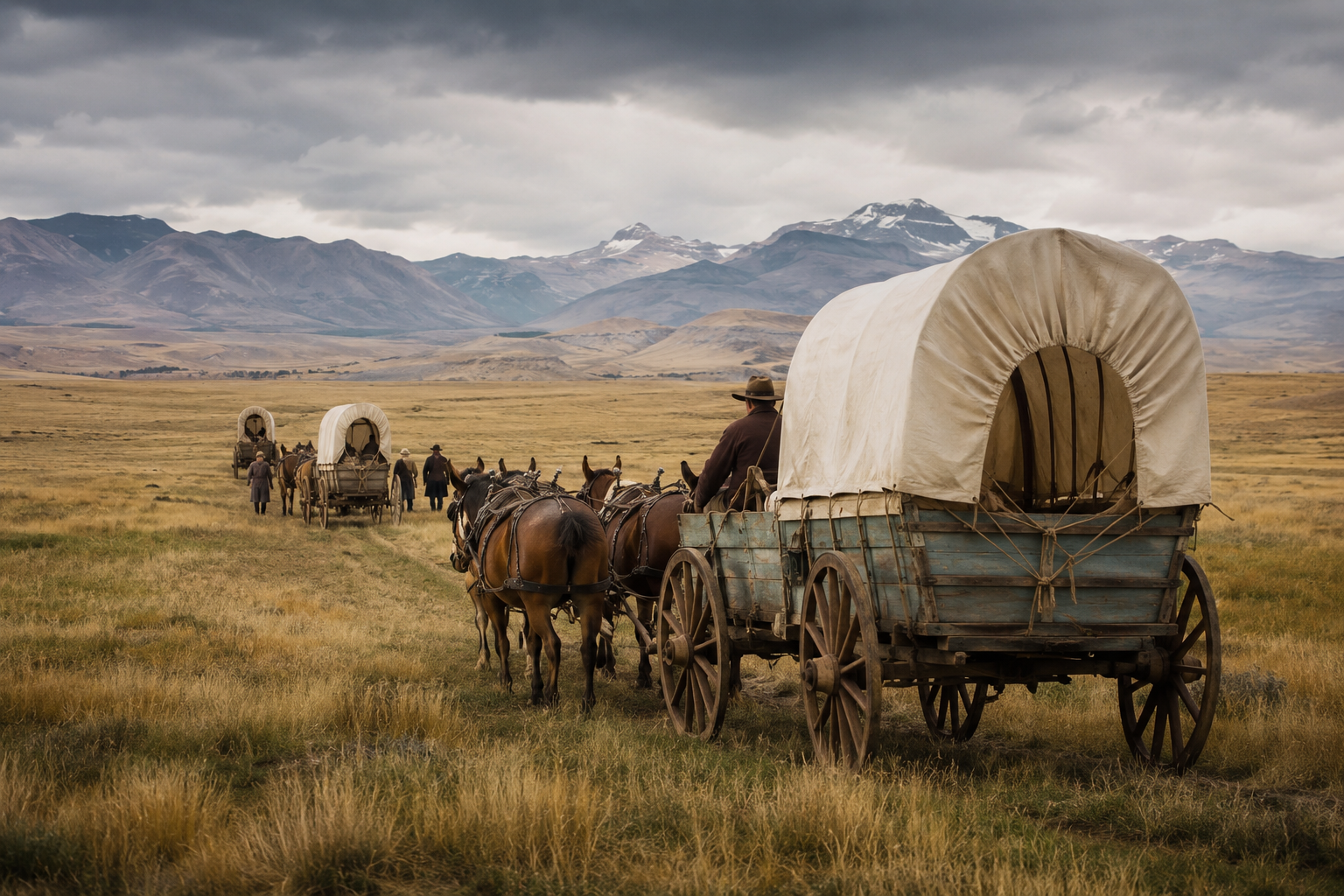
Between the 1840s and the 1860s, an estimated 400,000 settlers, farmers, miners and families loaded their lives into covered wagons and set out on the Oregon Trail, a roughly 2,000-mile route from the Missouri River to the Pacific Northwest. It was one of the largest voluntary migrations in human history.
Why They Went
The pull was land and opportunity. The fertile Willamette Valley in Oregon promised farmland, while later gold strikes in California and elsewhere drew fortune-seekers. Economic hard times in the East pushed many families to gamble everything on a fresh start.
The Journey
The trip took four to six months. Most travelers walked beside their wagons rather than rode, to spare the oxen. They followed rivers across the Great Plains, climbed through South Pass in the Rockies, and faced deserts and mountains before reaching their destination. Timing was critical: leave too early and there was no grass for the animals; leave too late and snow could trap a party in the mountains.
The Real Dangers
Contrary to popular imagination, conflict was not the main threat. The biggest killer by far was disease, especially cholera, which could strike a healthy person in the morning and kill them by night. Accidents — drownings at river crossings, firearms mishaps, children falling under wagon wheels — also took many lives. Graves lined the trail.
Landmarks Along the Way
Pioneers navigated by famous landmarks: Chimney Rock in Nebraska, Independence Rock in Wyoming (where travelers carved their names), and Fort Laramie, a vital resupply point. Reaching certain landmarks by certain dates told travelers whether they were on schedule.
Impact on Native Peoples
The migration cut directly through the homelands of many Native American nations. While early relations often involved trade and assistance, the sustained flood of settlers disrupted ecosystems, spread disease and ultimately fueled decades of conflict and displacement — a consequence that shaped the West for generations.
The Trail’s Legacy
The coming of the transcontinental railroad in 1869 made the wagon journey obsolete almost overnight. Today, deep ruts worn by thousands of wagon wheels are still visible in places, and the trail is preserved and interpreted at sites across several states. The Oregon Trail endures as a symbol of ambition, hardship and the complicated reality of westward expansion.