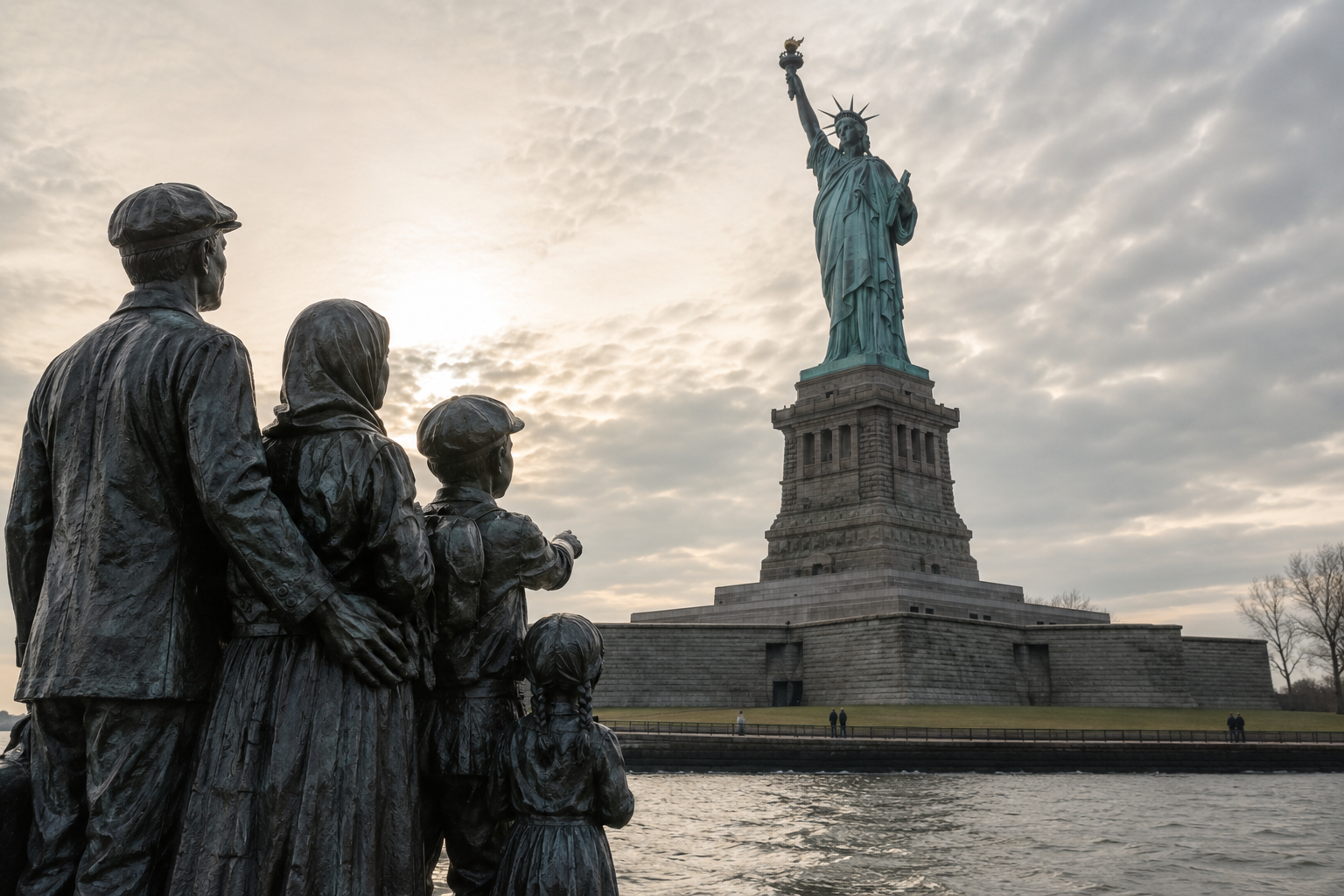
The Statue of Liberty is so familiar that it is easy to forget how unlikely it was — a colossal copper figure, conceived in France, shipped across the Atlantic in pieces, and assembled on an island in New York Harbor through years of fundraising struggles.
A French Idea
The statue began as a proposal by French thinkers who admired the United States and wanted to celebrate the friendship between the two nations and the shared ideal of liberty. The sculptor Frédéric Auguste Bartholdi designed the figure, “Liberty Enlightening the World,” and the engineer Gustave Eiffel — later of tower fame — devised the internal iron framework that lets the thin copper skin flex in wind and temperature changes without cracking.
Who Paid for What
In an unusual arrangement, France funded the statue itself while the United States was responsible for the pedestal. American fundraising stalled until newspaper publisher Joseph Pulitzer launched a campaign in his paper, promising to print the name of every donor no matter how small. Schoolchildren, workers and ordinary citizens sent in coins, and the pedestal was completed. The statue was dedicated in 1886.
The Engineering
The statue stands about 151 feet tall from base to torch, and over 305 feet including the pedestal. Its copper skin is roughly the thickness of two pennies. Originally a shiny reddish-brown, the copper slowly oxidized into the green patina we recognize today — a protective layer, not damage.
A Changing Symbol
The statue was first intended to represent liberty and the alliance of two republics. But because it stood in the harbor that received millions of immigrants arriving at nearby Ellis Island, it gradually became a symbol of welcome and opportunity. The poem by Emma Lazarus — “Give me your tired, your poor, your huddled masses yearning to breathe free” — was written to help fund the pedestal and was added to the statue on a plaque years later, cementing that association.
Visiting Today
- The statue sits on Liberty Island and is reached by ferry from Battery Park in Manhattan or Liberty State Park in New Jersey.
- Access to the crown is limited and requires reservations well in advance.
- The museum on the island displays the original torch, replaced during a 1980s restoration.
More than a tourist stop, the statue is a reminder that national symbols are not fixed — their meaning is written and rewritten by the people who look up at them.